
The circular economy is about more than reducing waste. It can also drive local economic development, create jobs and strengthen community resilience. That was one of my main takeaways from a thought-provoking event on circular textiles.
On November 9, I attended the “Textiles circulaires” (Circular Textiles) event, held as part of Entretiens Jacques Cartier in Montréal. The event brought together businesses, researchers, social economy organizations and local government representatives from Québec and France.
Beyond the recycling solutions and technological innovations presented, one idea particularly resonated with me: what if the circular economy encouraged us to rethink how we create prosperity, rather than simply how we manage waste?
A textile system reaching its limits
The scale of the challenge is striking. According to RECYC-QUÉBEC, 344,000 metric tonnes of textiles were disposed of in Québec in 2023, an increase of 114% since 2011. This volume highlights the limits of an economic model built around ever-growing production and consumption of products that are often used for too short a time.
The 2026 Responsible Consumption Barometer reveals an interesting paradox: 75.8% of Quebecers donate their clothing, yet 71.3% still purchase mostly new clothes, while only 10.2% prioritize second-hand purchases.
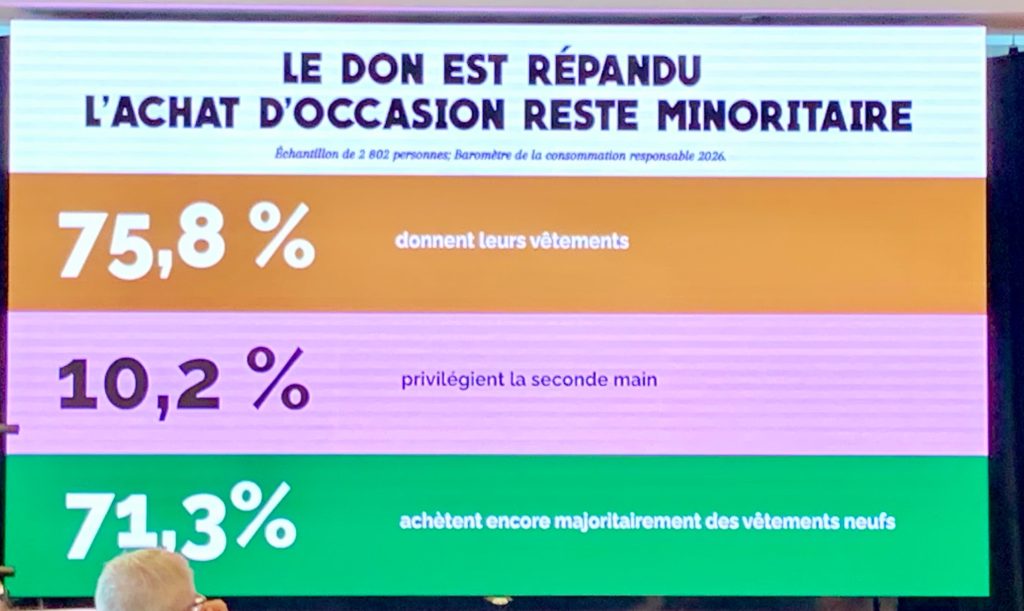
Donating clothes has become common practice. But it does not necessarily mean we have fundamentally changed the way we consume.
The first priority of a circular economy should therefore be to reduce our demand for virgin materials and extend the useful life of products. Reuse, repair and ecodesign should come before recycling, which still has an important role to play when materials can no longer be used in other ways.
Turning waste into economic resources
One of the presentations that stayed with me was given by Éric Boël, director of Les Tissages de Charlieu, a French company working to bring textile manufacturing, circularity and regional development together.
A compelling example is the French national railway company, SNCF, which helped develop a domestic industrial supply chain to recycle its employees’ worn work uniforms.
SNCF initially provided 23 metric tonnes of used clothing to help Nouvelles Fibres Textiles, a company established in part by Les Tissages de Charlieu, develop its automated sorting equipment. Garments are sorted by fibre composition and colour, then processed into fibres that can be used to manufacture new textiles or other materials.
The initiative brings together several businesses specializing in sorting, fibre recovery, spinning and weaving. It shows how collaboration across a value chain can create new industrial activities and help preserve local manufacturing expertise.
Another insight from the discussions concerned how recycled fibres are used. Instead of always trying to produce a recycled material identical to a virgin one, why not design products around the properties of the materials already available?
This reversal of the usual approach invites businesses to adapt their processes, products and business models to existing resources. For it to succeed, several conditions must be in place: sufficient material volumes, suitable technologies, viable markets and a sound business case.
This perspective also reflects our experience working with Québec textile manufacturers, where raw materials often account for a large share of greenhouse gas emissions. We explore these findings and practical solutions in our article “Decarbonization in the Textile Sector: Lessons Learned.”
Measuring environmental impacts to guide decisions
Another particularly interesting presentation came from Pierre Matteoni of France’s Agency for Ecological Transition (ADEME), who introduced Ecobalyse.
This free tool assesses the environmental cost of a garment using a life-cycle assessment approach.
The calculation considers greenhouse gas emissions, impacts on biodiversity, water and natural resource use, and different forms of pollution. It also incorporates certain factors related to product durability.
The result is expressed in environmental impact points: the higher the score, the greater the garment’s environmental cost.
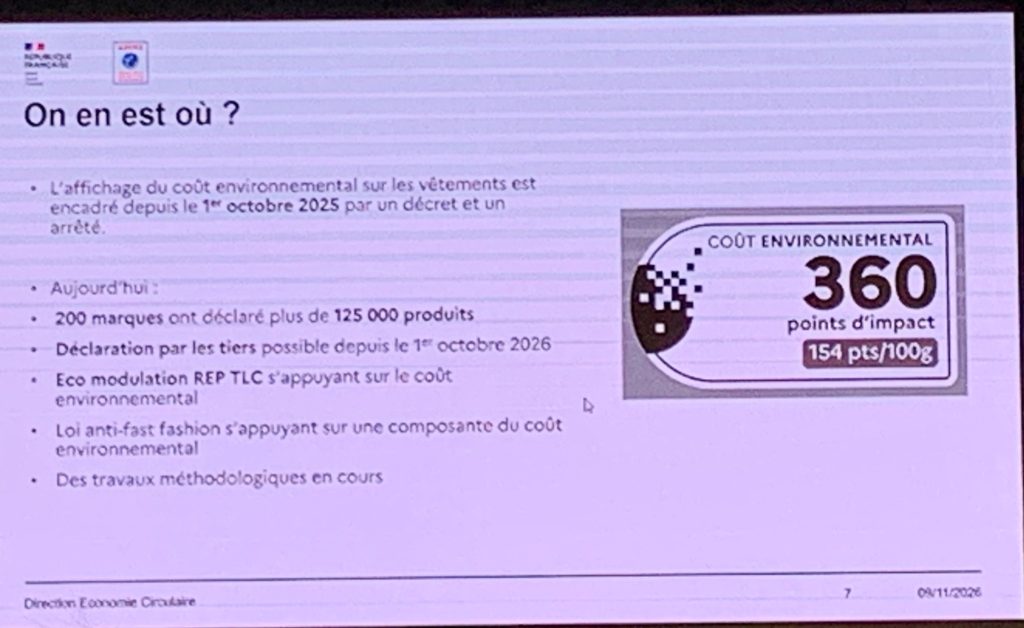
Since October 2025, France has had an official framework allowing brands to voluntarily display this environmental cost on their clothing.
The value of this approach goes beyond giving consumers more information. Making environmental impacts easier to see and compare can encourage companies to improve product design and support competition based on more than the purchase price alone.
The methodology continues to evolve, but it illustrates how life-cycle assessment can become a practical decision-making tool.
Creating the conditions for a local circular economy
The French experience also shows the importance of public policy and collective action.
Through its eXtrême Défi Textile Responsable initiative, ADEME supports projects that aim to reduce dependence on new clothing while developing local economic activities. In October 2026, 38 regional projects were selected for an initial ideation phase.
The goal is ambitious: to test new business models capable of creating value without depending on a constant increase in the number of new garments produced and sold.
In Québec, promising pathways are also emerging. An Équiterre report on textile reuse at the municipal level (available in French) outlines practical measures local governments can take to support reuse initiatives.
Municipalities can bring stakeholders together, support social economy enterprises and help build local networks for textile reuse and recovery.
Businesses also have much to gain from taking part. Alongside reducing their environmental footprint, they can diversify their activities, strengthen supply security and develop new partnerships.
Prosperity built together
One expression I heard during the event particularly resonated with me: the circular economy can help restore a balance of shared prosperity.
To me, that captures the broader potential of this approach.
The circular economy is not just about keeping materials in circulation. It can also strengthen ties among businesses, local governments, community organizations and residents, while keeping more value rooted in the communities where it is created.
Of course, scaling up remains a challenge. Collection, sorting, reuse and recycling all need economically viable models, without losing sight of the main objective: using fewer resources and reducing environmental impacts.
Still, the initiatives presented at Entretiens Jacques Cartier show that solutions are already taking shape.
What if the next step in our environmental transition were to make the circular economy not only an environmental strategy, but also a genuine economic development project for our communities?